

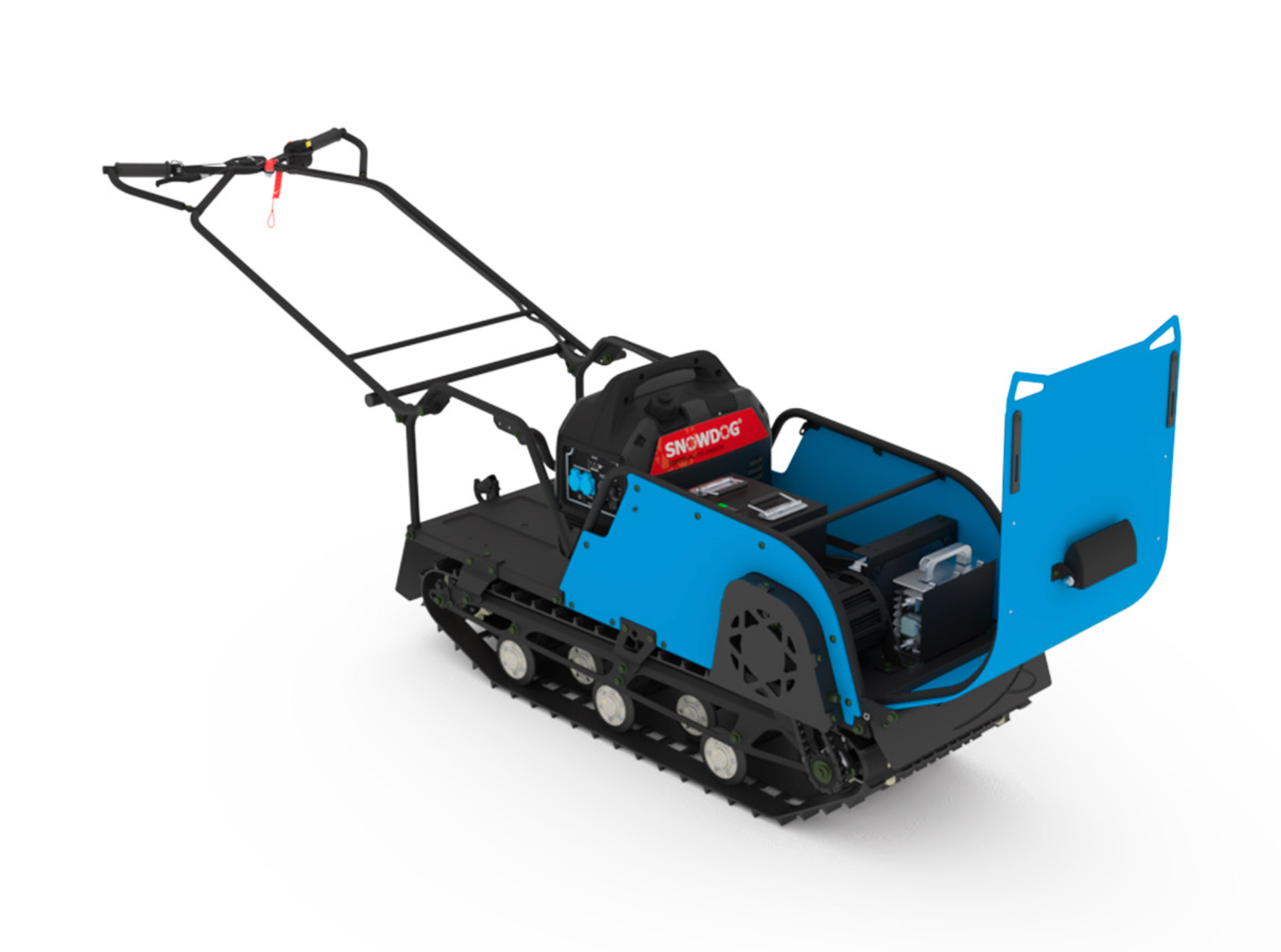
The new electric Snowdog X is shaping up to be a compelling option for users looking for a quiet, low-maintenance alternative to gas. After several weeks of near-daily winter use we at Recreation revolution have been able to see the Snowdog X’s performance in real conditions. Its smooth, quiet operation, predictable battery life, and elimination of fuel handling make it especially appealing for early-morning grooming runs, single lake fishing trips, and casual outings alike, while still retaining the familiar Snowdog feel.
Is the electric Snowdog X a real alternative to gas, or just a niche option?
Based on real-world use, it’s a legitimate alternative for specific use cases—particularly where noise, fumes, and short, repeatable runs matter more than brute-force trail breaking.
Grooming, Ice, and Recreational Use: Quiet, Predictable, and Easy to Live With
In real-world use, the electric Snowdog X excels where consistency, low noise, and simplicity matter most. For those that spend hours behind the machine, the lack of engine noise and exhaust is a meaningful improvement—particularly for early-morning or residential-area runs.
Battery performance has been solid for typical grooming sessions, delivering up to an hour of runtime on a single battery, with a full recharge in roughly 2.5 hours.
The elimination of gas also removes the risk of unreliable cold starts.
How long does the electric Snowdog X battery last in real use?
In typical grooming, ice, and recreational scenarios, users are seeing up to an hour of runtime on a single charge, with recharge times that make multiple outings in a day realistic.There is a an additional battery available which will double the run time (and charge time). There is also a generator that comes standard with the machine that can recharge or power the Snowdog X on low speed. We have not yet had a trip where we’ve run the battery low enough to require this.
Is an electric Snowdog good for trail grooming?
Yes—particularly for maintenance grooming, repeat passes, and noise-sensitive areas. It’s less ideal for consistently breaking untouched deep snow, which is where gas still has an edge.
Deep and Heavy Snow: Understanding the Electric Trade-Offs
Deep or heavy snow is where the electric Snowdog X behaves most differently from its gas counterparts. The electric motor is designed with protective limits and will reduce power or cut out under excessive load. In similar conditions, a gas Snowdog will continue pushing until the CVT belt overheats or burns out.
As with gas models, technique matters. Taking the time to lay an initial trail—by walking behind the Snowdog or carefully working it on and off the path—pays dividends. Once a track is established, each follow-up pass becomes progressively easier, and the electric Snowdog performs far more consistently.
Can an electric Snowdog handle deep snow?
Yes, but with a bit more more operator involvement. Breaking fresh, deep snow takes patience and technique, whereas gas models rely more on raw mechanical persistence.
Why does the electric Snowdog cut power in deep snow?
The system is designed to protect the motor and drivetrain by limiting output under excessive load, rather than risking damage.
Handling, Braking, and Real-World Operation
Some users have noted that the electric Snowdog X can feel like it lists slightly more than gas models. This may be influenced by snow conditions or weight distribution and hasn’t presented functional issues, but it is noticeable in certain terrain.The battery and motor are offset on either side of the machine to help combat this. Adding a second battery (we haven’t tried this yet) could compound the issue.
The electric model does not include a disc brake, unlike gas versions. In practice, the brake on gas Snowdogs primarily functions as a parking brake, not a true downhill stopping system. With both platforms, proper downhill operation relies on good judgment—reducing sled weight, disconnecting loads if needed, and committing to a controlled descent.
Does the electric Snowdog X have brakes?
It does not have a disc brake. Like gas models, safe downhill operation relies more on load management and operator technique than braking force. Braking sensitivity and power can be configured using Snowdog’s configuration program.
Is the electric Snowdog safe going downhill?
Yes, when operated properly. Best practices are similar for both gas and electric models.
Diagnostics and Configuration: Manufacturer-Level Tooling
The Snowdog X does include access to a diagnostics and controller configuration program, but it’s important to set expectations on how this is intended to be used. This software is not designed for widespread end-user tuning or customization. It requires a proprietary cable, direct guidance from Snowdog, and uses an interface that is partially in Russian—clearly aimed at technical users.
In practice, this tool is best thought of as a manufacturer and engineering support utility, used by Snowdog’s technical team to diagnose issues, validate performance, and assist with troubleshooting when needed. Most owners will never need to interact with it directly. The Snowdog X is designed to be operated as delivered, without configuration or ongoing tuning.
Can owners tune or modify the electric Snowdog’s motor settings?
Not in a practical or supported way. The system is intended to be set and supported by the manufacturer, not adjusted by end users.
Recreation Revolution Takeaway
The electric Snowdog X isn’t designed to replace gas in every scenario—but it offers a genuinely compelling alternative.
Quiet operation, reduced maintenance, and predictable charging make it especially attractive for grooming and short, repeatable trips. As an early electric platform, it shows strong promise—and for the right use cases, it’s already a very practical machine.
Should you buy an electric or gas Snowdog?
If your priority is quiet operation, low maintenance, and short, repeatable runs, electric is worth serious consideration. If you regularly break deep, untouched snow or haul heavy loads long distances, gas still holds the advantage.

Share: